

The CGA's new Crypto Policy bans mixers and sanctioned wallets immediately and sets a June 2027 deadline for full blockchain screening, the clearest sign yet that the island's light-touch era is ending.
Curaçao has been the reflexive licensing choice for crypto casinos for a decade, and the arrangement asked almost nothing of the operators who used it. Curaçao licenses roughly 450 active online gambling operators today, by one industry count, on an island with a population of about 160,000 people. Its regulator just told all of them the free pass is over.
The Curaçao Gaming Authority (CGA) published a Crypto Policy guideline on 24 June 2026 that bans crypto casinos from accepting funds tied to mixers, tumblers, or sanctioned wallets immediately, and gives licensees until June 2027 to build full wallet-screening and blockchain-analytics systems. CGA marketing and PR advisor Aideen Shortt shared the document on LinkedIn rather than through the regulator's own site, itself a small sign of how fast this moved. The guideline states plainly that licensees "cannot operate blindly with regard to crypto transactions."
This creates a fork in the road.


What the CGA now requires
The guideline covers the entire crypto lifecycle, deposit to withdrawal to treasury. The guideline applies to every group entity that touches crypto, not just the license holder itself. Its requirements split into four categories.
- Role restriction. Licensees may accept crypto only for gambling, never as an exchange, custodian, or virtual asset service provider (VASP) converting, swapping, or holding crypto for players outside actual bets.
- Asset controls. Fiat-backed stablecoins are preferred. Privacy coins such as Monero and Zcash, meme coins, and wrapped tokens of unclear origin must be risk-assessed or excluded entirely.
- Wallet controls. Player, operational, and treasury wallets stay segregated, and personal or owner-linked wallets are banned outright.
- Banned outright. Funds traceable to mixers, tumblers, or sanctioned addresses cannot be accepted under any circumstance. Operators have three months to file a compliant crypto policy with the CGA, six months to finish risk assessments and staff training, and twelve months, by June 2027, to reach full technical compliance. That means wallet segregation, blockchain analytics, transaction reconciliation, and audit-ready records all working together. The CGA can accelerate any of those deadlines if it spots a serious risk in the meantime.
Why the pressure landed now
The Financial Action Task Force (FATF) flagged Curaçao's gambling sector as a money-laundering risk in a 2020 review. FATF's regional affiliate, the Caribbean Financial Action Task Force (CFATF), followed up directly, running a full evaluation of Curaçao with an on-site visit in June 2024. Its findings, adopted at CFATF's plenary in May 2025, placed Curaçao under enhanced follow-up, meaning the island must keep proving progress or risk landing on the FATF grey list.
The evaluation found something specific and damning. As of the on-site visit, Curaçao was still assessing its own virtual asset sector, five active VASPs whose customer base, transaction volumes, and values the report called simply unknown. The gambling sector, meanwhile, ranked among the highest money-laundering risks in the country's own national assessment. Dutch pressure ran alongside the FATF track. The reform was tied to conditions on pandemic-era financial aid from the Netherlands, and Dutch lawmakers passed a motion pushing Curaçao to tighten AML oversight specifically.
The old regime that got Curaçao here
The old system ran on trust nobody verified. The old system let four private companies, Antillephone, Curaçao eGaming, Gaming Curaçao, and Cyber Rock Entertainment, sell sub-licenses to anyone who paid, with almost no questions asked about who actually ran the casino or where the crypto came from. Its footprint was enormous by the time reform arrived, something close to 1,200 operators traced back to those four master licenses.
The National Ordinance on Games of Chance, known by its Dutch abbreviation LOK, replaced that system entirely when it took effect 24 December 2024. Legacy sub-licenses expired in January 2025, and the CGA now issues every license directly. The public register lists more than 330 active licenses today, barely a quarter of what existed under the old model.
A measurement war nobody has settled
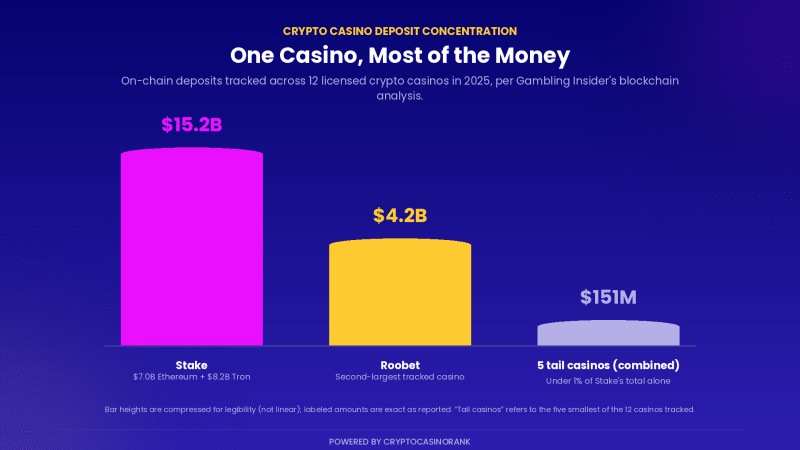
Gambling Insider tried to settle an argument the industry couldn't settle on its own. Gambling Insider tracked deposits flowing into 29 labeled wallets across 12 casinos, using public blockchain data anyone can independently verify on the analytics tool Dune. Its number came to $22.7 billion in 2025 deposits, with Stake alone accounting for $15.2 billion, split between $7.0 billion on Ethereum and $8.2 billion on Tron. Roobet came in second at $4.2 billion. Five smaller "tail" casinos combined for just $151 million, under 1% of Stake's total alone.
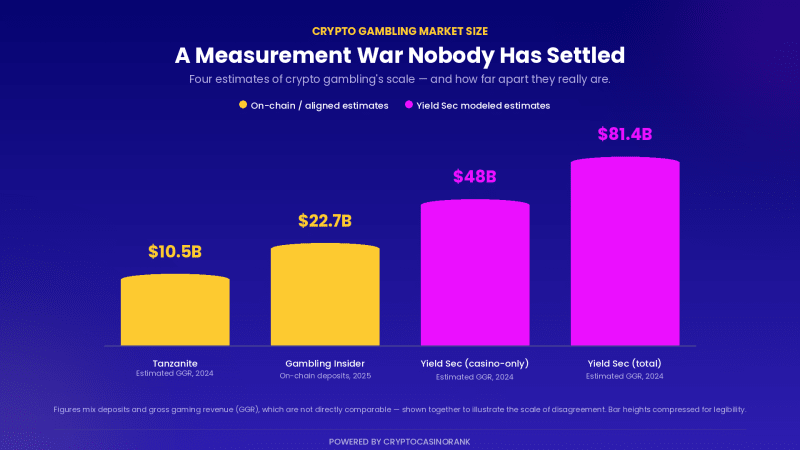
That count sits nowhere close to the industry's most cited number. Analytics firm Yield Sec puts global crypto gambling GGR at $81.4 billion for 2024, a figure first reported by the Financial Times, with casino-specific revenue accounting for $48 billion of it. Rival analytics firm Tanzanite puts the real number closer to $10 to $11 billion, in line with what Gambling Insider's own on-chain count actually found. For Yield Sec's figure to hold, the gambling nobody can see would need to run seven to fourteen times larger than everything currently measured on-chain.
We have a broad definition of what crypto gambling is.

The hack that explains the mixer ban
North Korea's Lazarus Group is the reason mixers made this guideline's first line. North Korea's Lazarus Group stole roughly $41 million from Stake-controlled wallets in September 2023, and the FBI confirmed the attribution days later. Its laundering path ran through Tornado Cash, then the Avalanche Bridge, then the Sinbad mixer, the exact kind of hop-and-obscure route the CGA's new wallet-screening rules are built to catch. The hack predates this guideline by three years, but the pattern it exposed, funds erasing their origin one mixer at a time, is precisely what Recommendation 16 of the FATF's Travel Rule, which the CGA guideline explicitly cites, exists to interrupt.
Enforcement has already made an example
Small House B.V., the entity behind BC.Game, lost its Curaçao license in late 2024. Small House B.V. went through bankruptcy proceedings that left more than $2.5 million in player claims unresolved. Its response was not to fix the problem. The brand's licensing simply moved to Anjouan, a jurisdiction with even less oversight than Curaçao's old regime, underscoring the industry's standing worry that tighter rules on one island just push weaker operators to the next one.
The real test of this guideline isn't the June 2027 deadline, it's whether the CGA actually revokes a major license before then. Curaçao has proven it can write strict rules. What it hasn't proven yet is that it will enforce them against a brand generating real revenue for the island rather than a bankrupt operator with nothing left to lose. Watch for the first enforcement action against an active, profitable license holder, not another failed one, that's the signal this guideline has teeth.


Where Curaçao now sits
Other regulators reached the same conclusion years earlier, just with less noise. Other regulators, in Malta, Gibraltar, and the Isle of Man, already require anti-money laundering (AML) controls on crypto gambling and exclude privacy coins outright. Their common thread is treating crypto like any other regulated payment rail instead of an exception carved out for convenience. The Isle of Man is the jurisdiction most often cited as the most credible tier-one market that expressly permits virtual assets at all.
Compliance is not free, and it will not land evenly. Blockchain-analytics tooling of the kind the CGA now expects runs a five- to six-figure annual cost on top of the roughly €47,450 license fee, a bill that lands hardest on smaller tier 2 and tier 3 operators rather than the majors. PaymentIQ senior business development manager Andrew Christodoulou put the split bluntly. Operators with proper infrastructure already in place "will absorb these changes without breaking a sweat," he said. Everyone else faces a harder choice, build the compliance stack or drift toward a lighter-touch jurisdiction that hasn't caught up yet.
No fine under the new crypto guideline has been reported so far. The next FATF plenary that could reassess Curaçao's standing meets in October 2026, four months after this guideline landed and eight months before operators are required to fully comply with it.