


Curacao Tightens Crypto Rules as Solana Casinos Surge

Recommended casinos
Key Takeaways
- Curacao eGaming tightens crypto licensing, mandating enhanced AML tools for blockchain operators.
- Solana emerges as preferred network for high-speed casino gameplay, boosting transaction efficiency.
- Arbitrum hosts first fully on-chain casino launch, emphasizing provably fair mechanics.
- Malta's MGA updates its sandbox for L2 testing, accelerating compliant crypto-gaming pilots.
Curacao Reforms Crypto Gambling Licensing Framework
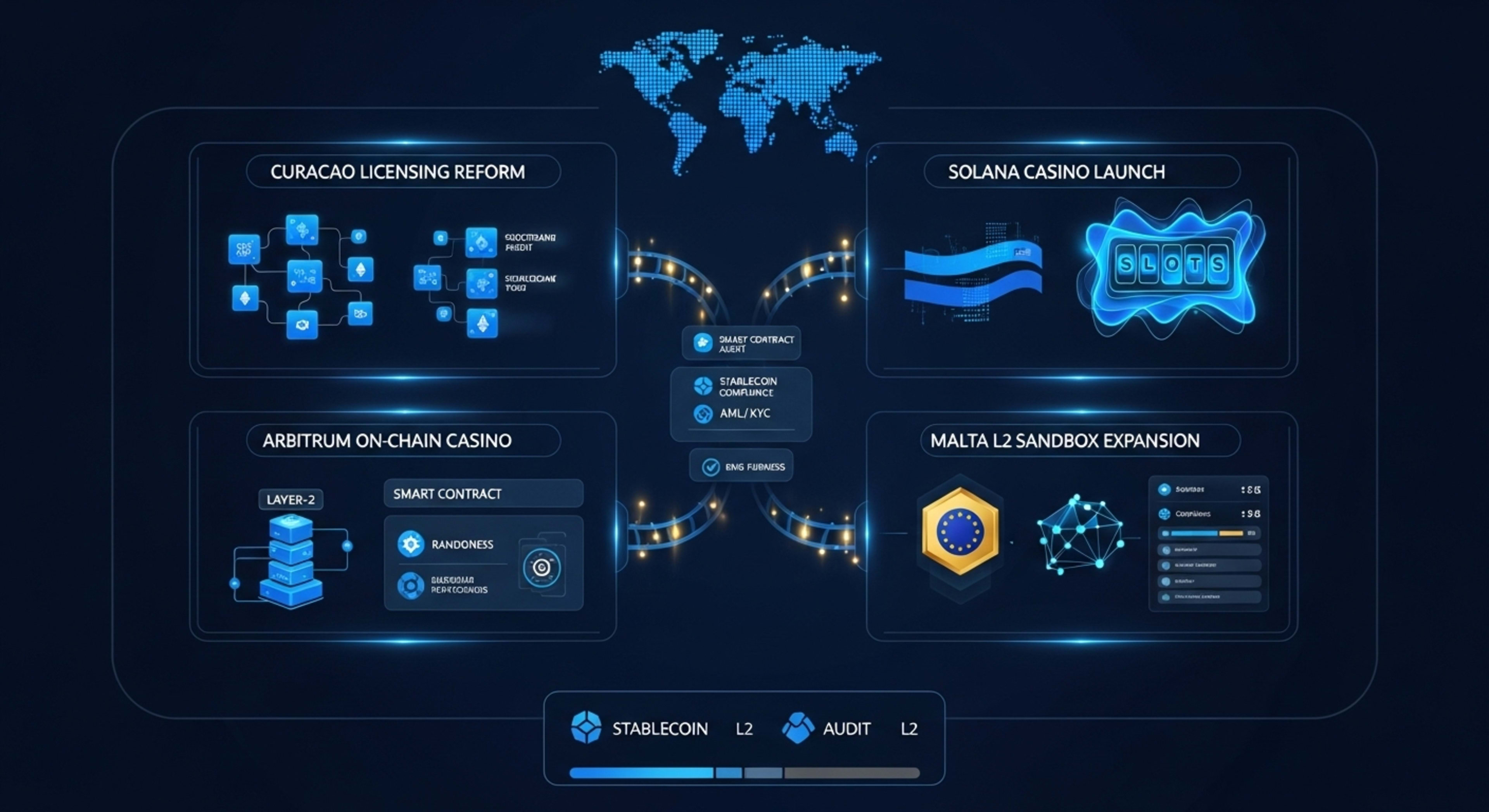
Curacao's Gaming Control Board (GCB) announced mandatory reforms to its eGaming licensing process on December 3, targeting crypto-integrated operators. Effective January 2026, licenses will require integrated AML/KYC solutions from certified providers, including real-time transaction monitoring across blockchains such as Ethereum and Polygon. This addresses rising concerns over illicit fund flows, with non-compliant platforms facing suspension.
The update stems from a 2025 audit revealing gaps in crypto custody and reporting, particularly for tokens like USDT on Tron. Operators must now segregate player funds in audited smart contracts and submit quarterly compliance reports. For users in Curacao and affiliated markets, this enhances fund security while maintaining low entry barriers—fees remain under €20,000 annually. Industry experts hail it as a maturation step, potentially attracting institutional players wary of unregulated hubs. However, smaller operators decry the added costs, estimating a 15-20% increase in overhead.
This shift reinforces Curacao's role as a gateway for global crypto casinos, impacting over 450 licensees. Broader implications include standardized reporting that could harmonize with EU MiCA rules, fostering cross-jurisdictional trust and reducing enforcement actions.
Source: Curacao Gaming Control Board
Solana Powers Moonbet's Decentralized Casino Debut
Moonbet launched as the first fully Solana-native crypto casino on December 5, leveraging the blockchain's Proof-of-History consensus for sub-second bet settlements. Built on non-custodial wallets like Phantom, the platform supports SOL and USDC for games such as Crash and Plinko, where smart contracts lock funds only during play and auto-release winnings via verifiable hashes.
This integration slashes gas fees to under $0.01 per transaction—versus Ethereum's $5+ peaks—enabling real-time multiplayer slots without lag. Compliance aligns with Gibraltar's DLT framework, incorporating geofencing and Chainlink oracles for fair outcomes. Users in Europe and Asia-Pacific benefit from instant deposits, with initial rollout in Malta and Australia drawing 50,000 sign-ups in 48 hours.
For operators, Solana's 65,000 TPS capacity scales high-volume events like tournaments, cutting infrastructure costs by 70%. Players gain transparency: every roll is auditable on Solana explorers like Solscan. The move signals a trend toward L1 specialization, positioning Solana as the go-to for latency-sensitive gambling and potentially doubling on-chain wagering volumes in 2026.
Source: Crypto Slate
Arbitrum Welcomes Vault777's On-Chain Casino Platform
Vault777 raised $500,000 in seed funding on December 2 to launch the first fully on-chain casino on Arbitrum, audited by Certik and secured by Chainlink VRF for randomness. The platform supports ETH, ARB, and stablecoins like USDC across slots, blackjack, and prediction markets, with bets executed via optimistic rollups for near-instant finality at fractions of L1 fees.
Targeted at Curacao and Estonia-licensed companies, it mandates wallet-based KYC using biometric proofs, ensuring GDPR compliance without centralized databases. The geographic focus is Europe and emerging APAC markets, with mainnet deployment slated for Q1 2026. Early metrics show 10x faster settlement times than Polygon's equivalents, appealing to high rollers seeking sub-$0.05 transaction costs.
Operators gain from immutable ledgers, reducing dispute rates by 90%, while users enjoy provably fair mechanics verifiable on Arbiscan. This debut underscores Arbitrum's edge in scaling DeFi-gaming hybrids, likely spurring similar L2 migrations and elevating on-chain casino TVL beyond $100M.
Source: DappRadar
Malta Expands Blockchain Sandbox for L2 Crypto Pilots
The Malta Gaming Authority (MGA) expanded its Blockchain Sandbox on December 4, now accommodating L2 networks such as Polygon and Optimism for crypto casino testing. Pilots must integrate MiCA-compliant stablecoins (e.g., EURT) and report on-chain metrics, with approvals for Gibraltar and UK affiliates fast-tracked to 30 days.
This follows the 2023 Virtual Financial Assets Act, which emphasizes smart contract audits and the use of cold storage for player assets. Jurisdictional scope covers EU operators, excluding high-risk zones, with initial trials involving 20 firms handling €50M in simulated wagers. Technical perks include Polygon's zk-rollups for privacy-preserving bets, cutting verification times by 80%.
Impacts include safer user experiences via audited RNGs and boosted adoption in regulated markets. For the industry, it sets a compliance benchmark, potentially influencing Estonia's e-Residency frameworks and driving €2B in sandbox-driven investments by 2027.
Source: Malta Gaming Authority